

February 24, 2026 | By Mikko Kurki | 10 min read
Selecting and Implementing Future-Flexible Technology
At the beginning of a journey to data driven performance management it is essential to review your existing systems, platforms, and processes. In previous articles, we have stated that research from 2025 found only around 37% of Fortune 1000 businesses have become truly data driven, even though over 98% have invested in data projects.
A situation that is common for many organisations, teams can often find themselves not lacking tools, but lacking the cohesion of a business wide vision that brings all of the information from all of the individual platforms together and integrates with an ERP system to create a single source of truth for all departments.
Selection of tools is always a strategic decision, but the challenge for many organisations is that these decisions are often made independently of each other.
Finance and tech choose an ERP because it solves immediate operational needs. Sales and tech select a CRM on a separate timeline and later IT is asked to introduce a BI platform to bring everything together. This pattern is what we’ve termed the ‘sequential myth’: the belief that systems can be selected one by one and stitched together later.’
As part of Staria’s journey to data driven performance management, stage 2 of this journey is all about assessing your current position so that you can select and implement the correct future-flexible technology for you:
Are you at the very beginning of your journey, a CEO, CFO or decision maker looking for how to curate the best scalable tech stack that will help you make more informed decisions as a business?
or
Are you experiencing the sequential myth, wondering how you bring all of your platforms together to create one single source of truth for teams across your business?
For both of these scenarios, the answer is the same. Your focus should shift to selecting and implementing the right technology, particularly the combination of ERP and BI, to turn your reporting visions into reality. This stage is about making strategic, joined up technology decisions that support stronger reporting, faster insight and a more connected organisation, no matter where you’re starting from.
In this blog, we’ll cover:
The result of misaligned systems and importance of selecting the right tech stack from day one.
If you already have systems in place how to connect them and break free from the sequential myth.
Long term vision for why the right combination of ERP and BI is critical and how to implement it correctly while empowering the people who use it.
An invitation to view our topical webinar for deeper insight.

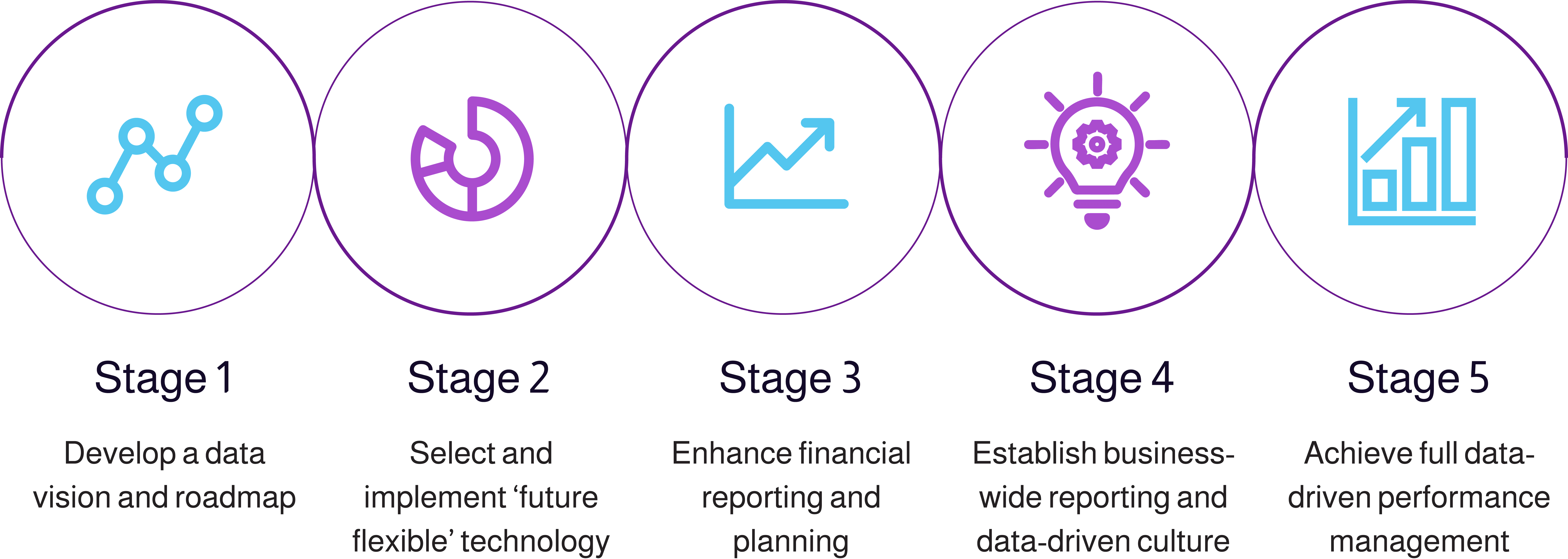
A Staged Approach to Data-Driven Performance Management
The result of misaligned systems
A recent study from the University of Oxford found that 85% of senior leaders have led major transformations in the past five years. Yet, two-thirds say at least one failed to meet expectations. A key reason: teams often struggle to select systems that genuinely fit their needs and integrate well with existing processes.
The difficulty often starts long before implementation. Different teams make system decisions at different times, based on their own priorities and levels of maturity. As a result, the organisation ends up with tools that were never planned together and do not naturally align.
These systems may work well individually, but they become difficult to connect and scale as a single ecosystem. Bringing them together later usually requires heavy technical effort, limits usability and prevents the business from getting a clear, unified view of its data.
With the right alignment from the start, organisations can avoid this fragmentation, selecting tools that work together and support the wider business from day one.
Why selecting the right technology matters
Instead of focusing on tools in isolation, the goal should be to build a connected data and planning ecosystem from day one, where ERP and BI complement each other, support shared strategic objectives, and give teams the clarity and confidence they need to use data well.
The real purpose of BI and planning technology alongside an ERP is to give teams (who, unlike finance, don’t spend the majority of their time in a number-focused role) the confidence to use data in everyday decision making. ERP remains the transactional and functional backbone, but the combination of ERP and BI together fosters bigger picture thinking across all departments, driving action and accountability as a result.
When evaluating an ERP and BI, the shared key criteria are:
Integration as a core requirement
Clear reporting and planning requirements from day one and for future stages
The technical capability and process for onboarding new data sources, e.g., a data warehouse to onboard CRM or operations software
Strong reporting and visibility across teams
Ease of report creation and interaction for non-technical users
Ability to support company-wide adoption, not just finance and a structure that enables shared ownership of data
Drawing on our experience from hundreds of successful ERP and finance transformations as Europe’s leading NetSuite partner, we advise all clients to consider BI as part of their initial review and ERP project. This ensures that the technology and approach to analysing data are present throughout the team and able to grow from day one.
Read more about why NetSuite is the The #1 Cloud ERP.
Evaluating ERP as your cornerstone solution
We understand that you may already have an ERP in place, with committed contracts, terms and significant investment and rightfully may not be in the position to take on a new ERP right now. However, with eyes on future-flexible tech, it is important to take key learnings from your current systems to determine what you require when it comes to re-evaluating down the line. Look at what’s working, what’s not, and with hindsight in mind what you wished you’d done first time round.
When next evaluating an ERP platform, look for:
A robust financial core (GL, AP/AR, consolidation, multi-entity support)
Reliable native integrations or connectors to BI, CRM, HR, and operational tools
Process automation and workflow capabilities
Scalability for multi-entity, multi-currency, and regulatory growth
A strong ecosystem of extensions and implementation partners
Native AI application in relevant functions as well as the ability to integrate external agents.
Read our complete guide to ERP implementation for tips on how to succeed in your implementation.
Evaluating and selecting the right BI & planning platform
Selecting the right BI and planning platform is more than a quick choice; it shapes how effectively your business will report, analyse, forecast, and embed the behaviours needed for a data-driven culture.
To build a future-flexible tech stack, BI should be considered from day one - not added after ERP and CRM decisions have already been made. However, if you already have siloed systems and are looking to implement a BI platform to integrate those systems and bring them together now, the objective is to create a platform that supports today’s reporting needs while being quick to adopt, easy to integrate, and able to scale for tomorrow.
When evaluating a BI and planning platform, look for:
Advanced reporting, analytics, and forecasting capabilities
Flexibility to combine any and all data sources
A scalable data platform and warehouse that supports future systems
Dashboards that are intuitive and easy to maintain
The ability to surface insight quickly for decision-making
Something which provides a low or no-code interface to allow end users to own their own reports.
Naviloq is built for exactly this scenario. Its integrated data warehouse allows organisations to consolidate finance, CRM, and operational data into one unified structure without having to rebuild a reporting landscape later. Where traditional planning modules can struggle to incorporate platforms like Salesforce or HubSpot, Naviloq is designed to integrate them seamlessly and can easily integrate new ERPs should you decide to change them further down the line.
Selection of the best platforms for your business is challenging. It is a large task and lengthy process that should not be undermined and getting to this stage is already a huge step forward in creating a streamlined data driven culture. With eyes on what’s next you must look at the implementation process to properly prepare and roll out your new systems in an optimal fashion.
Webinar
Don’t buy blind: How to select the right CFO office technology
Learn how a unified finance tech strategy, centered on ERP and BI, can boost adoption, accountability, and agility by focusing on selecting the right tools. Get practical insights to avoid common pitfalls and build a future-ready finance stack.

Preparing your systems, processes, and people for implementation
Technology alone will not transform performance. CFOs are facing increased pressure to deliver more insight, more accuracy, and more strategic value while operating under tighter budgets and rising expectations.
They are now expected to act not only as financial leaders but also as technology decision-makers, choosing systems that help the business move faster and stay ahead of customer and market demands. We have outlined three key areas to assess when preparing your business for implementation:
Audit data sources
Identify where core data currently lives and how it flows through the business. This includes finance systems, CRM platforms, spreadsheets, operational tools, and any manual reporting processes. The goal is to understand what data is available, how consistent it is across teams, and which sources will need to be connected to BI and ERP.
Assess data quality
Review whether the data is complete, accurate, up to date, and structured in a way that supports reporting. Look for duplicates, gaps, inconsistent naming, or conflicting versions of the same metric. Poor-quality data becomes a major barrier during implementation, so addressing these issues early prevents delays and rework.
Ensure key sources can integrate with your new BI
Confirm that the systems you rely on can be connected easily via standard integrations or APIs. This includes ERP, CRM, HR, operational tools and any additional platforms you plan to adopt in the future. The aim is to ensure that BI can draw from all relevant data without relying on complex, manual workarounds.
But readiness doesn’t stop with systems. People are just as important:
Train users early
Involve functional leaders beyond IT
Build shared ownership of BI across the organisation
Shift culture from gut-feel to data-informed decisions
Ask yourself the key question:
Are your teams equipped and aligned to get value from the technology you’re deploying?
Aligning implementation with strategic and operational goals
A successful implementation is outcome-first, not tool-first. Start by defining the operational outcomes you want to achieve, for example:
Faster month-end close
More accurate forecasting
Real-time visibility across the business
Stronger performance management
Together an ERP system and BI platform create a connected finance and operational ecosystem, empowering teams to plan, analyse, and act with confidence.
To guide implementation, ask:
What outcome do we want in the next 12 months?
Which teams will benefit first?
Who will use the platform day-to-day?
How will success be measured?
Academic and industry research consistently finds that integrated ERP-BI improves operational efficiency and cross-functional collaboration. When teams work from the same live numbers, decisions are faster, better, and easier to execute.
Conclusion: Laying the foundation for future-flexible growth
Stage 2 is about assessing where you are in your journey, translating vision into execution, selecting the right technology and preparing your organisation to use it.
This is not a finance project. It’s not an IT project. It’s a business-critical decision that affects reporting, forecasting, planning, and performance across every function as you know it.
With systems working together, backed by a clear strategy, businesses create the foundation needed to thrive today and beyond. In the next stage, we dive into how FP&A software supports in aligning the finance function with the wider business.
If you’re planning your next stage of BI and/or ERP development, now is the time to get the foundations right. Contact us to discuss your ambitions and identify the best path forward for a connected, future flexible tech stack.
Guide
The journey to data-driven performance management
In this guide, we share insights on what effective data-driven performance management looks like, and how to build a roadmap that makes it achievable. Whether you’re just starting out or aiming to build on your existing business intelligence capabilities, this guide will help you take the next step with confidence.


Subscribe
Join our monthly newsletter for valuable updates like blog posts, and upcoming events and webinars.